Home Solar Battery Storage Cost in India 2026 — and Whether You Even Need One
A solar battery sounds essential — until you see the price and the subsidy fine print. Here's what 5, 10 and 20 kWh of home storage actually costs in 2026, why the government subsidy skips the battery, and the honest answer to whether you should buy one at all.
Kunwer Sachdev
Inverter Man of India
30+ years in inverter & battery industry
📅 June 2026⏱ 10 min read🇮🇳 India · Rooftop solar + storage
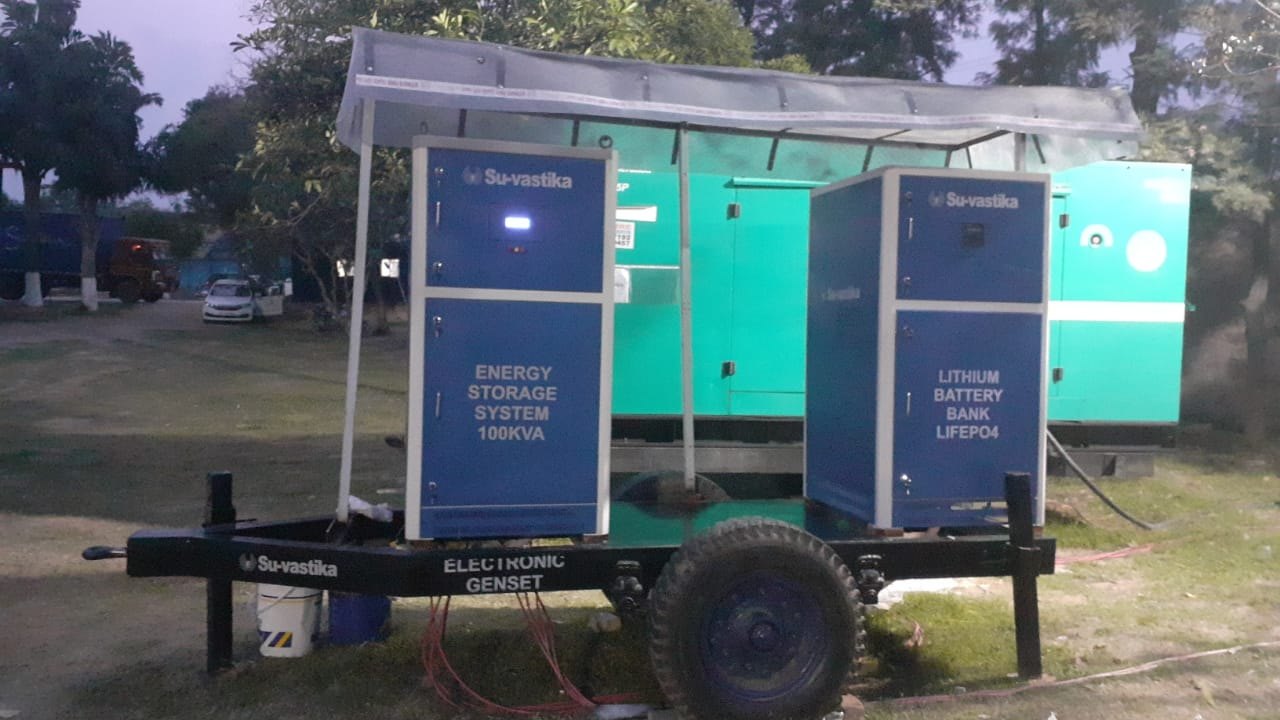
A real LFP (lithium) energy-storage system in the field — the chemistry recommended for home solar storage. (Author's own field installation.)
Rooftop solar is one of the best investments an Indian household can make — but the moment a salesperson adds "and a battery for backup," the quote can jump by lakhs. The battery is often the single most expensive part of the system, and the part the government subsidy quietly leaves out.
So before you sign, two questions matter: what does storage actually cost in 2026, and do you even need it? This brand-neutral guide answers both — no installer paid to appear.
⚡ The short answer
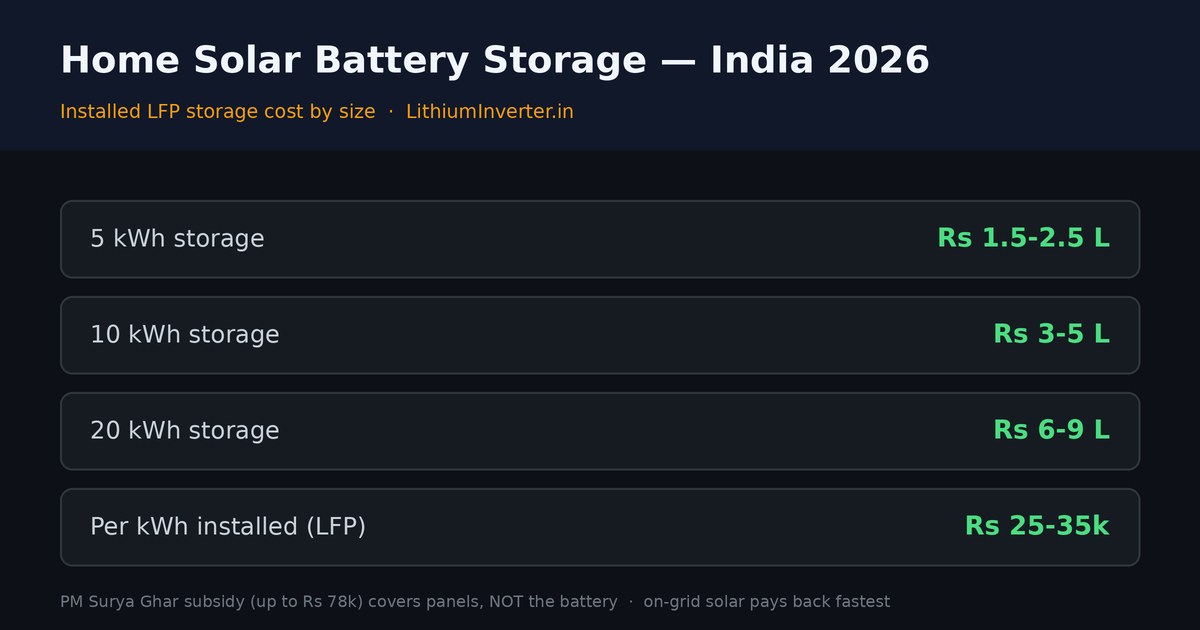
LFP home storage costs about ₹25,000–35,000 per kWh installed — roughly ₹1.5–2.5 lakh for 5 kWh, ₹3–5 lakh for 10 kWh. The PM Surya Ghar subsidy (up to ₹78,000) covers panels, not the battery. And if you have reliable grid power and net metering, you may not need a battery at all — on-grid solar pays back fastest.
What Home Solar Storage Costs in 2026
Prices below are indicative installed costs for LFP (lithium) battery storage including the hybrid inverter, before the solar panels themselves. Storage scales close to linearly with kWh.
Storage size
Installed cost (battery + hybrid inverter)
Typical use
5 kWh
₹1.5 – ₹2.5 lakh
Backup for essentials, small home
10 kWh
₹3.0 – ₹5.0 lakh
Most of a home overnight
20 kWh
₹6.0 – ₹9.0 lakh
Large home / near off-grid
Per kWh (installed)
₹25,000 – ₹35,000
LFP, integrated retail
Full solar + storage examples
System
Indicative total (2026)
3 kW solar + 5 kWh battery (hybrid)
₹2.5 – ₹3.5 lakh
5 kW solar + 10 kWh battery (hybrid)
₹5.5 – ₹7.0 lakh
Figures are indicative 2026 market estimates and vary by city, brand and roof. For live rates, see the solar battery price index.
Installed LFP storage cost by size, 2026 — the subsidy doesn't cover this part.
The Subsidy Reality — It Doesn't Cover the Battery
This trips up almost every first-time buyer. The PM Surya Ghar: Muft Bijli Yojana subsidy is generous, but specific:
₹30,000 per kW for the first 2 kW, plus ₹18,000 for the third kW — capping at ₹78,000 for any 3 kW or larger rooftop system.
It applies to the grid-tied solar panels and setup — not the battery.
Small "balcony" or portable-battery solar setups usually fall outside the scheme entirely.
Plan around it: claim the ₹78,000 on your panels, but budget the battery as a separate, unsubsidised cost. A common honest structure is a subsidised grid-tied solar system plus a battery only as large as your real backup need — not a giant pack the installer would love to sell you.
Do You Even Need a Battery?
The uncomfortable truth many installers won't lead with: if your grid is reliable and you have net metering, a battery may not pay for itself. Match the system to your situation:
On-grid (no battery) — cheapest, fastest payback (3–4 years with subsidy). Daytime solar runs the house; surplus is exported for credit; the grid is your "battery" at night. Best where power cuts are rare.
Hybrid (solar + battery) — adds backup during outages and stores daytime solar for night use. Costs more and lengthens payback, but gives independence. Best where cuts are frequent.
Off-grid — no grid connection at all; needs the largest, most expensive battery. Only for remote sites.
A simple rule: buy the battery for the outages you actually have, not for fear of the grid. If you lose power for a couple of hours occasionally, a modest 5 kWh pack covers essentials. Sizing storage to "run everything for a day" is where budgets explode for little real benefit. To size it properly, see our inverter battery sizing guide.
Payback & Chemistry
The maths, simply: on-grid solar pays back in 3–4 years with subsidy. Adding storage stretches payback to roughly 6–12 years depending on tariffs and usage — but the solar lasts ~25 years and a good LFP battery 8–12 years, so it still ends up ahead over the system's life, especially where outages are costly.
On chemistry, LFP (lithium iron phosphate) is the right call for home storage: safe, 3,000–6,000 cycles, no maintenance, and tolerant of Indian heat. Tubular lead-acid is cheaper upfront but cycles far fewer times — for daily solar cycling, LFP wins on cost per year. See the full chemistry comparison.
From 30+ years in batteries — Kunwer Sachdev: Two things decide whether home solar storage is worth it. First, a good solar hybrid PCU should run your loads on solar even when the grid is present — that's where the real bill savings come from, not just backup. Pair it with an MPPT charge controller (about 30% more efficient than PWM) and an LFP battery, and let the system hold a reserve so the pack never deep-discharges — that single feature is what makes a lithium pack last 8–12 years. Second, don't oversize. The most expensive mistake I see is buying a huge battery "so you never run out," then cycling it lightly and paying for capacity you never use. Size storage to your evening load and your real outage pattern, keep it LFP, and a sensible solar investment stays sensible.
The Bottom Line
Home solar storage in 2026 costs about ₹25,000–35,000 per kWh — ₹1.5–2.5 lakh for 5 kWh, ₹3–5 lakh for 10 kWh — and the PM Surya Ghar subsidy won't help with that part. Claim the subsidy on your panels, then add storage sized to the outages you genuinely face, in LFP chemistry. If your grid is reliable and you have net metering, the cheapest, fastest-payback path may be solar with no battery at all.
How much does a 10 kWh solar battery cost in India?
About ₹3–5 lakh installed (battery + hybrid inverter), at roughly ₹25,000–35,000 per kWh for LFP. A full 5 kW solar + 10 kWh hybrid system is around ₹5.5–7 lakh.
Does PM Surya Ghar cover the battery?
No — the subsidy (up to ₹78,000 for 3 kW+) covers the grid-tied solar panels only, not battery storage.
Do I need a battery with solar?
Not necessarily. With reliable grid power and net metering, on-grid solar without a battery has the fastest payback. A battery mainly buys backup during outages.
What's the payback on solar with storage?
Around 6–12 years for solar-plus-storage, versus 3–4 years for on-grid solar without a battery.
Which battery is best for solar storage?
LFP (lithium iron phosphate) — safe, long-cycling, maintenance-free and heat-tolerant.
Founder of Su-Kam and Kunwwer.ai, and mentor at Su-vastika and several other companies — the “Inverter Man of India.” Read his story →
Disclaimer: This article is written by Kunwer Sachdev, mentor of Su-vastika. Kunwer Sachdev is no longer associated with Su-Kam Power Systems Ltd. in any capacity. Anyone dealing with Su-Kam should be aware that Kunwer Sachdev has no association with the Su-Kam brand or company.