Inverter Battery Specs Compared 2026 — What the Brands Don't Tell You
Every brand prints "150Ah" and "long life" — and hides the specs that actually decide how your battery performs and how long it lasts. You can't compare spec sheets that don't exist. So here's the better way: the specs that matter, what brands disclose versus hide, and the exact numbers to demand before you pay.
Kunwer Sachdev
Inverter Man of India
30+ years in inverter & battery industry
📅 June 2026⏱ 9 min read🇮🇳 India · Independent analysis
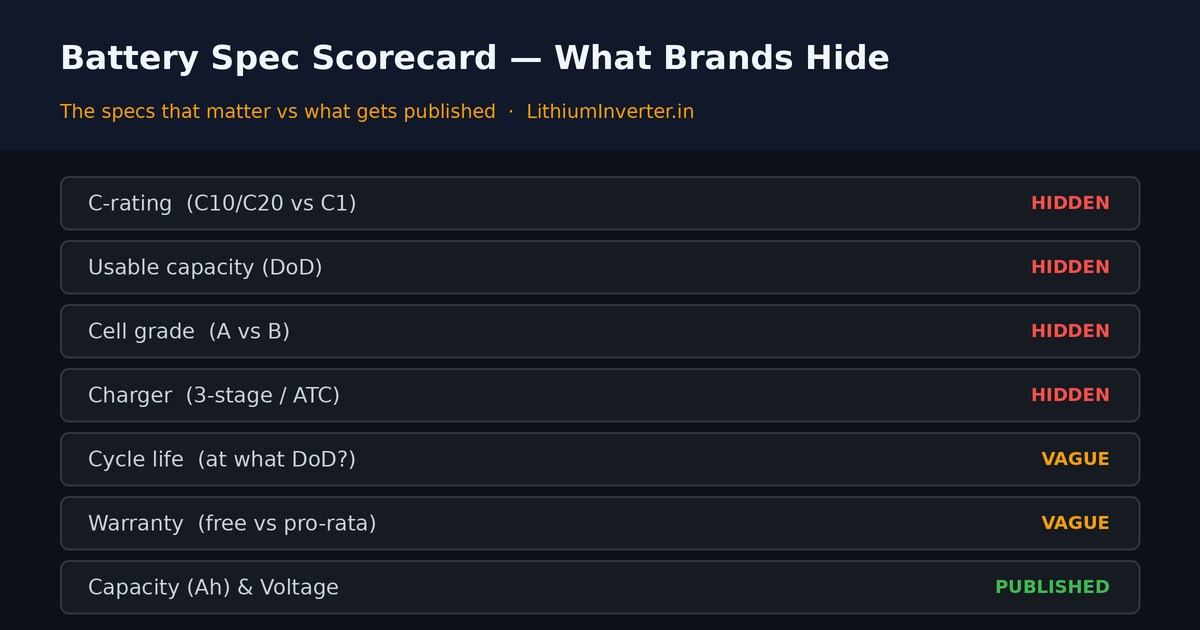
The spec-transparency scorecard: what brands publish (green), state vaguely (amber), or hide (red).
Here's the uncomfortable truth about comparing battery brands in India: you can't, on their spec sheets. Almost every brand publishes the same three things — capacity in Ah, voltage, and a marketing line like "long life" or "maintenance-free." The numbers that actually decide whether the battery performs and lasts are simply not printed. That's not an accident; it's how thin spec sheets hide weak products behind big claims.
So instead of pretending to compare sheets that don't exist, this guide does something more useful: it lists the specs that matter, scores what the market typically discloses versus hides, and gives you the exact numbers to demand — in writing — so you can compare any two brands like-for-like.
⚡ The short version
Ignore "150Ah, long life." Demand these instead: C-rating, usable Wh (Ah × DoD), cycle life at a stated DoD and end-of-life %, backup at your real load, cell grade & origin, BMS current & protections, charger type (3-stage/ATC), and the warranty free-vs-pro-rata split. If a seller won't put those in writing, that silence is your answer.
The 10 Specs That Actually Matter
For each spec: why it matters, what brands usually publish, and what's hidden or vague that you must ask for.
Spec
Why it matters
Status
What to demand
C-rating
Decides usable capacity at real load. Tubular C10/C20 ≠ lithium C1.
Hidden / fine print
The exact C-rating (C10, C20 or C1)
Usable capacity (DoD)
Lead-acid gives ~50% usable, LFP ~90%. Ah alone is misleading.
Hidden
Usable Wh = Ah × voltage × DoD
Cycle life
"3000 cycles" is meaningless without DoD & end-of-life %.
Vague
Cycles at a stated DoD to a stated % (e.g. 80% DoD → 80% capacity)
Backup at real load
Showroom backup figures assume tiny loads.
Vague
Runtime at your actual load in watts
Cell grade & origin
A-grade vs B-grade cells perform and age very differently.
Hidden
Cell grade (A), cell maker, country
BMS (lithium)
Controls safety, balancing, real continuous current.
Vague
Continuous & peak current, protections, balancing type
How much you lose charging/discharging — affects bills.
Hidden
% efficiency (LFP ~95%, lead-acid ~80%)
Operating temperature
India's heat derates capacity & life.
Vague
Working range & derating above 40°C
Warranty split
"5-year" may be 2 free + 3 pro-rata.
Vague
Free months vs pro-rata, in writing
The pattern: the specs marked red — C-rating, usable DoD, cell grade, charger and efficiency — are exactly the ones that separate a great battery from a repackaged cheap one. Their absence from a spec sheet is information.
The Two Hidden Numbers That Matter Most
1. C-rating — the "200Ah" illusion
A tubular battery is rated C10 or C20: it only delivers its full Ah if you drain it slowly over 10–20 hours. A lithium LFP battery is C1 — it delivers rated capacity in about an hour. So a "200Ah" tubular cannot supply that capacity at a real 400W+ load, while a smaller lithium can. Brands print the big Ah number and bury the C-rating, which is why two batteries with the same "Ah" can give wildly different real backup.
2. Cell grade — the "100Ah" that isn't
In lithium packs, A-grade cells are factory-fresh, fully tested and matched. B-grade or reclaimed cells are rejects with weaker, inconsistent capacity and thinner safety margins. Cheap packs use B-grade cells and never say so — so two "100Ah" lithium packs can differ by years of life and a real safety gap. Always ask for the cell grade, maker and origin.
"A spec sheet that only shows Ah and 'long life' is not a spec sheet. It's an advertisement."
From 30+ years in batteries — Kunwer Sachdev: In all my years, the two numbers customers are never shown are the ones I'd check first: the C-rating and the cell grade. Everything else — backup time, cycle life, even safety — flows from those. A battery built on B-grade cells with a poor BMS and the wrong charger will fail early no matter how big the Ah number on the sticker. Ask for the C-rating, the cell grade and origin, the cycle life at a stated depth of discharge, and the charger specification. An honest brand answers immediately. If you get silence or a sales line instead of a number, you've learned what you needed to know.
Demand These 8 Numbers Before You Pay
Copy this and ask the seller to fill it in — in writing, on the invoice or quotation:
C-rating — C10, C20 or C1?
Usable energy — usable Wh (capacity × depth of discharge), not just Ah.
Cycle life — number of cycles, at what DoD, down to what % capacity.
Backup time — at my load in watts (give them your number).
BMS / charger — continuous current & protections (lithium); 3-stage/ATC charger & charge current (tubular).
Efficiency & temperature — round-trip %, working temperature range.
Warranty split — how many months free vs pro-rata, in writing.
How to use it: ask two or three brands the same eight questions and compare the answers side by side. The brand that answers all eight clearly — with numbers, not adjectives — is almost always the better battery, regardless of who has the flashiest ad. For the brands themselves, see our top 6 inverter battery brands and lithium brand comparison.
The Bottom Line
You can't compare inverter battery brands on their spec sheets, because the sheets are built to hide, not inform. The fix is to know which numbers matter — C-rating, usable DoD, cycle life conditions, cell grade, charger, efficiency, warranty split — and demand them in writing. Do that, and you turn a marketing guessing game into a real, like-for-like comparison. That's the only honest way to compare batteries in India today.
Frequently Asked Questions
What specs do battery brands hide?
Mainly the C-rating, usable depth of discharge, cycle life conditions, cell grade/origin, charger type and round-trip efficiency — while publishing only Ah, voltage and "long life."
What is C-rating?
How fast a battery can deliver its capacity. Tubular is C10/C20 (slow), lithium is C1 (fast) — so the same "Ah" gives very different real backup.
What is A-grade vs B-grade cell?
A-grade cells are fresh, tested and matched; B-grade are rejects/reclaimed with weaker, inconsistent performance and lower safety. Cheap packs use B-grade and don't disclose it.
Which numbers should I demand before buying?
C-rating, usable Wh, cycle life at a stated DoD/end-%, backup at your load, cell grade & origin, BMS/charger specs, efficiency & temperature, and the warranty free-vs-pro-rata split — all in writing.
Why can't I just trust the Ah number?
Because Ah without C-rating and usable DoD doesn't tell you the real, usable energy at your load. Two "150Ah" batteries can perform very differently.
Founder of Su-Kam and Kunwwer.ai, and mentor at Su-vastika and several other companies — the “Inverter Man of India.” Read his story →
Disclaimer: This is independent educational analysis of how battery specifications are disclosed in the Indian market; it does not allege wrongdoing by any specific brand. Written by Kunwer Sachdev, mentor of Su-vastika. Kunwer Sachdev is no longer associated with Su-Kam Power Systems Ltd. in any capacity.