Battery Failed Within Warranty but the Company Won't Replace It? Here's Exactly What to Do
Your inverter or EV battery died well inside its warranty — and the company found a reason to say no. You are not powerless. This guide collates the common denial excuses, your rights under the law, and the exact emails to send, to which department, to actually get it resolved.
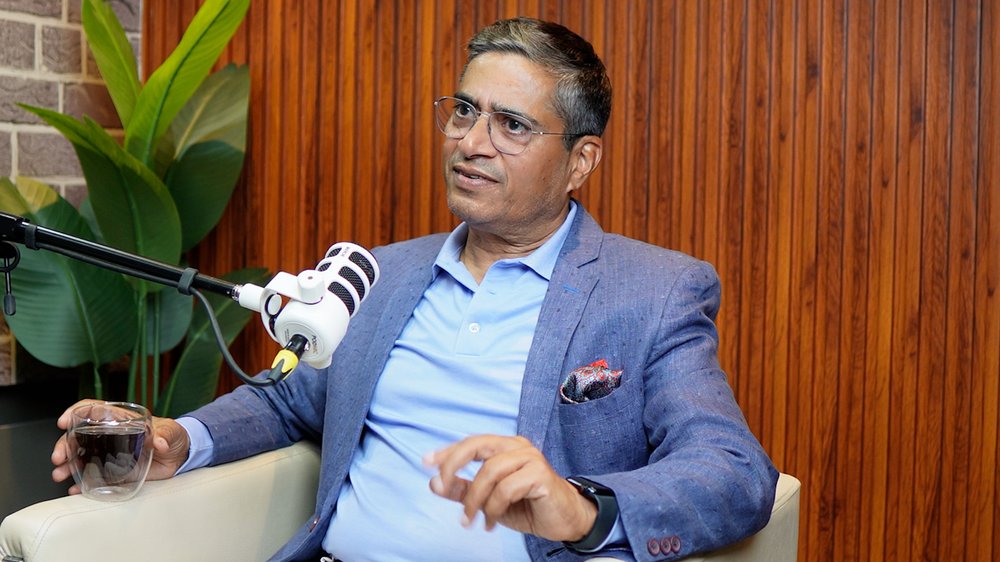
Kunwer Sachdev
Inverter Man of India
30+ years in inverter & battery industry
📅 June 2026⏱ 11 min read🇮🇳 India · Inverter & EV batteries
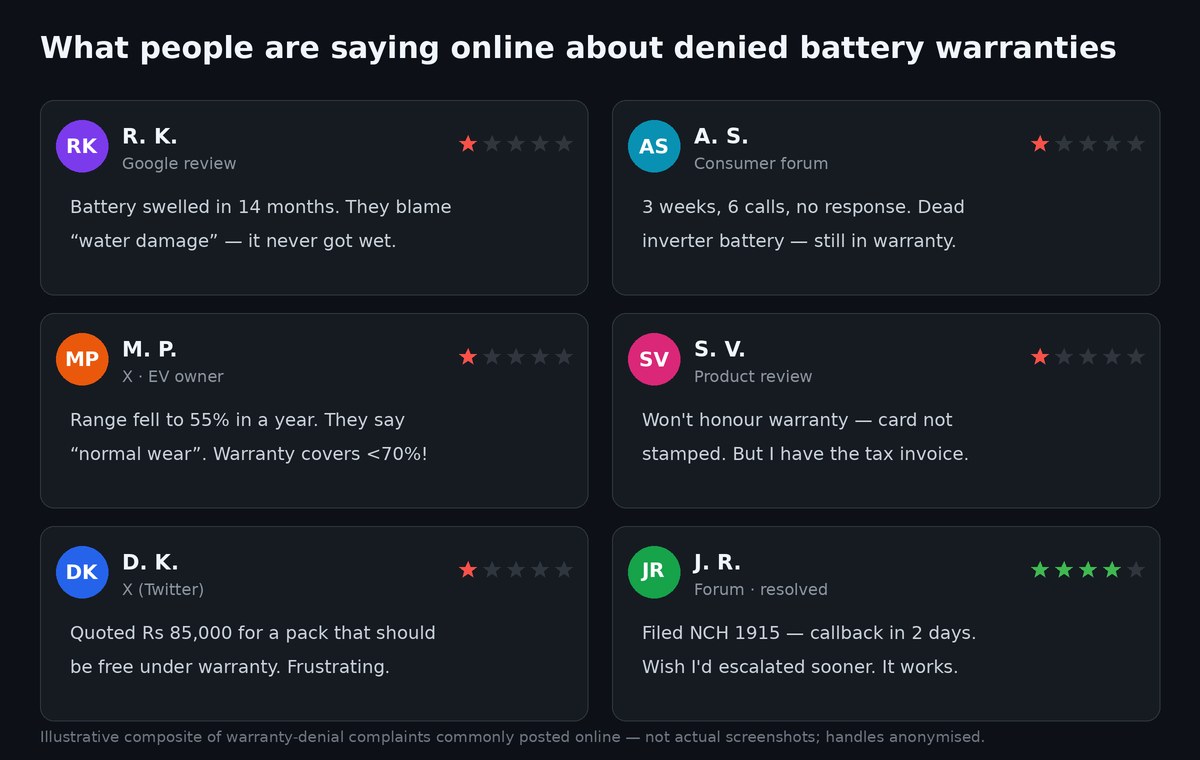
Representative of warranty-denial complaints commonly posted on review sites, forums and social media. Illustrative composite for context — not actual screenshots; handles anonymised.
It is one of the most common — and most maddening — experiences in India's battery market. You buy an inverter battery, an EV scooter, or a solar storage pack with a confident "5-year warranty" or "8-year / 30,000 km" promise. Eighteen months later it swells, loses half its range, or simply dies. You raise a claim. And the company, instead of replacing it, reaches for one of a dozen familiar reasons to say no.
Sometimes the denial is fair — warranties genuinely don't cover everything. But very often it is a stall, a script, or a way to wear you down until you give up. The good news: India's consumer law is firmly on the side of the buyer, and most genuine claims get resolved the moment the customer escalates correctly. This guide shows you exactly how.
⚡ The 60-second version
Get every refusal in writing. Then escalate in four steps: (1) customer care with a ticket number, (2) the company's Nodal / Grievance Officer, (3) the National Consumer Helpline — 1915, and (4) a complaint on e-Daakhil before the Consumer Commission. Most claims are settled long before step 4. Ready-to-send email templates are below.
The 8 Reasons Companies Use to Deny In-Warranty Claims
Across inverter and EV battery brands, the same excuses appear again and again. Here is what each one means — and, in green, the reality you can push back with.
1. "Physical / transit damage"
A dent or crack is blamed for the fault. But a cosmetic mark unrelated to the failure isn't grounds to void a manufacturing defect. Ask for the technical link in writing.
2. "Water ingress / corrosion"
Common for inverter batteries. Legitimate only if water actually caused the fault — demand the inspection report, not a verbal claim.
3. "Serviced by an unauthorised person"
Valid if a third party opened the pack. But routine top-up or normal use is not "tampering." Keep all service done through the brand.
4. "Deep discharge / negligence"
Used a lot for EV and lithium packs. A good BMS should prevent damaging discharge — if it didn't, that points to a defect, not your fault.
5. "Warranty card not stamped / lost"
Brands reject claims for paperwork gaps. A tax invoice with serial number is strong proof of purchase even without the card.
6. "Wrong application / overloading"
They claim you used it beyond spec. Ask them to point to the exact clause and show how your usage breached it.
7. "Only pro-rata, not free replacement"
Many inverter warranties are part free + part pro-rata. Insist they show the slab in the written warranty terms — and apply it correctly.
8. "Capacity drop is normal wear"
For lithium/EV: degradation below the stated threshold (often 70%) is usually a covered warranty event, not "normal wear." Quote the clause back.
The one move that changes everything: never accept a verbal "no." Politely insist the company put its denial in writing, with the specific warranty clause and the technical reason. A written refusal is either honest (and you'll know where you stand) or indefensible (and it becomes your strongest evidence in escalation).
Know Your Rights: The Law Is on Your Side
A warranty is not a favour — it is a binding promise, and failing to honour a valid one is a "deficiency in service" under the Consumer Protection Act, 2019. As a consumer you have the right to:
A written reason for any rejection, citing the exact clause.
An independent inspection — you can dispute a one-sided "technician said so" verdict.
Replacement, repair, or refund, plus compensation for harassment and financial loss where a court finds deficiency.
A grievance officer — every brand of any size is expected to have a Nodal / Grievance Redressal Officer reachable by email.
"A warranty you have to fight for is still a warranty. The companies that deny in-warranty claims are betting you'll get tired before they do. Don't."
The Escalation Ladder — 4 Steps to Resolution
You rarely need all four rungs — most genuine claims settle at step 2 or 3, once the company sees a paper trail forming.
Which Department to Email — and Exactly What to Write
1
Customer Care / Service Desk
Your first written record. Find the support email on the brand's website or warranty card. The goal here is a complaint/ticket number, not a resolution yet.
✉️ Template 1 — First written complaint to Customer Care
To: [brand customer care email]
Subject: In-warranty battery failure — request for replacement — [Model], Invoice [No.]

Dear Customer Care Team,

I purchased a [brand + model, e.g. 150Ah LFP inverter battery / Ola S1 Pro]
on [date] (Tax Invoice No. [____], Serial No. [____]), which carries a
[5-year / 8-year] warranty.

The battery has developed the following fault within the warranty period:
[describe — e.g. "capacity dropped to ~50%", "swelling", "will not hold charge"].

I request a free in-warranty inspection and replacement as per your warranty
terms. Kindly:
1. Register this complaint and share a ticket/complaint number,
2. Schedule an inspection within 7 days, and
3. Provide any decision IN WRITING, citing the specific warranty clause.

Attached: invoice, warranty card, photos/video of the fault.

Regards,
[Name] · [Phone] · [Address]
2
Nodal Officer / Grievance Redressal Officer
If customer care stalls or denies without a written, clause-based reason within 7–15 days, escalate here. Find the Nodal/Grievance Officer's email under "Grievance Redressal", "Contact Us", or the warranty terms on the brand's website.
✉️ Template 2 — Escalation to the Nodal / Grievance Officer
To: [nodal/grievance officer email]
Cc: [customer care email]
Subject: ESCALATION — unresolved in-warranty battery claim — Ticket [No.]

Dear Sir/Madam,

Despite raising complaint [ticket no.] on [date], my valid in-warranty
battery claim remains unresolved / has been denied without a written,
clause-based reason.

Facts: [model], purchased [date], Invoice [no.], within [X]-year warranty;
fault: [____]. This appears to be a deficiency in service under the
Consumer Protection Act, 2019.

I request resolution — free replacement/repair — within 7 days of this email.
If I do not receive a satisfactory written response, I will be constrained to
approach the National Consumer Helpline and the Consumer Disputes Redressal
Commission, and to claim compensation for harassment and financial loss.

Attached: invoice, warranty card, prior emails, photos/video.

Regards,
[Name] · [Phone] · [Address]
3
National Consumer Helpline (NCH) — 1915
A free government service that takes up your grievance with the company. Call 1915 (or 1800-11-4000), WhatsApp +91-8800001915, or register at consumerhelpline.gov.in. You'll get a docket number — keep it.
4
e-Daakhil — the Consumer Commission
Still no resolution? Send a written legal notice (15-day deadline), then file online at edaakhil.nic.in. The District Commission (DCDRC) handles claims up to ₹50 lakh; filing fees are nominal (around ₹100–200 for small claims) and you can represent yourself.
⚖️ Template 3 — Legal-notice intent (final email before filing)
To: [nodal officer email] ; [customer care email]
Subject: FINAL NOTICE before consumer complaint — Ticket [No.] / NCH Docket [No.]

Dear Sir/Madam,

This is a final opportunity to resolve my in-warranty battery claim
([model], Invoice [no.], NCH Docket [no.]) before I file a complaint
before the District Consumer Disputes Redressal Commission via e-Daakhil
and seek replacement plus compensation and costs.

Please confirm free replacement/repair within 15 days of this notice.

Regards,
[Name] · [Phone] · [Address]
Build Your Evidence File (Do This First)
Escalation works because of paper. Before you send a single email, gather and scan:
Tax invoice with serial number — your core proof of purchase.
Warranty card and the printed/online warranty terms.
Photos and a video of the fault (swelling, error code, range display).
Every email, chat and SMS with the company — never rely on phone calls alone.
Any technician/service report you were given.
Your NCH docket number once you reach step 3.
Two habits that win cases: (1) put everything in writing — convert every phone promise into a follow-up email ("As discussed, you confirmed…"); and (2) stay factual and polite. Calm, documented persistence beats anger every time, and reads far better if a case ever reaches the Commission.
From 30+ years in this industry — Kunwer Sachdev: A genuine manufacturing defect almost always shows up early and follows a pattern the company's own data already knows. Reputable brands honour those claims quickly. When a company instead hunts for an excuse on a clearly in-warranty failure, a calm, well-documented escalation usually flips the decision — because they know a paper trail in front of a Consumer Commission is a fight they will lose.
The Bottom Line
A denied in-warranty battery claim is not the end of the road — it's the start of a process the law has built specifically for you. Get the refusal in writing, climb the ladder one rung at a time, and keep your evidence file tidy. Most people who escalate correctly never even reach the Consumer Commission — the written, documented pressure resolves it well before then.
Can a company legally deny an in-warranty battery claim?
Only for genuine exclusions — physical damage, water ingress, unauthorised service, wrong application, or use beyond the warranty terms. A blanket refusal without inspection or a written, clause-based reason can be a deficiency in service under the Consumer Protection Act 2019, which you can challenge.
Which department should I email first?
Customer care, to get a written ticket number. Then the Nodal / Grievance Officer if it stalls, then the National Consumer Helpline (1915), then e-Daakhil.
What is the National Consumer Helpline number?
Dial 1915 (or 1800-11-4000), WhatsApp +91-8800001915, or register at consumerhelpline.gov.in to get a docket number.
What does filing a consumer case cost?
Filing on e-Daakhil before the District Commission is inexpensive — around ₹100–200 for small claims — and you can represent yourself without a lawyer.
How long does the whole process take?
Many claims resolve within 2–4 weeks at the customer-care or nodal-officer stage once a paper trail forms. A full Consumer Commission case takes longer, but is rarely needed for a clearly in-warranty failure.
Founder of Su-Kam and Kunwwer.ai, and mentor at Su-vastika and several other companies — the “Inverter Man of India.” Read his story →
General information, not legal advice: This guide explains common consumer-redressal steps in India and is for educational purposes only. Warranty terms, exclusions and pecuniary limits vary by brand and may change. For your specific situation, verify the official portals above and, where needed, consult a qualified consumer-rights lawyer or advocate.
Disclaimer: This article is written by Kunwer Sachdev, mentor of Su-vastika. Kunwer Sachdev is no longer associated with Su-Kam Power Systems Ltd. in any capacity. Anyone dealing with Su-Kam should be aware that Kunwer Sachdev has no association with the Su-Kam brand or company.