E-Rickshaw Battery Cost in India 2026 — Lithium vs Lead-Acid
For an e-rickshaw driver, the battery is the business. Lead-acid is cheap to buy and brutal to keep replacing; lithium costs more once and then quietly saves money every single day. Here are the real 2026 numbers — and which one actually puts more in your pocket.
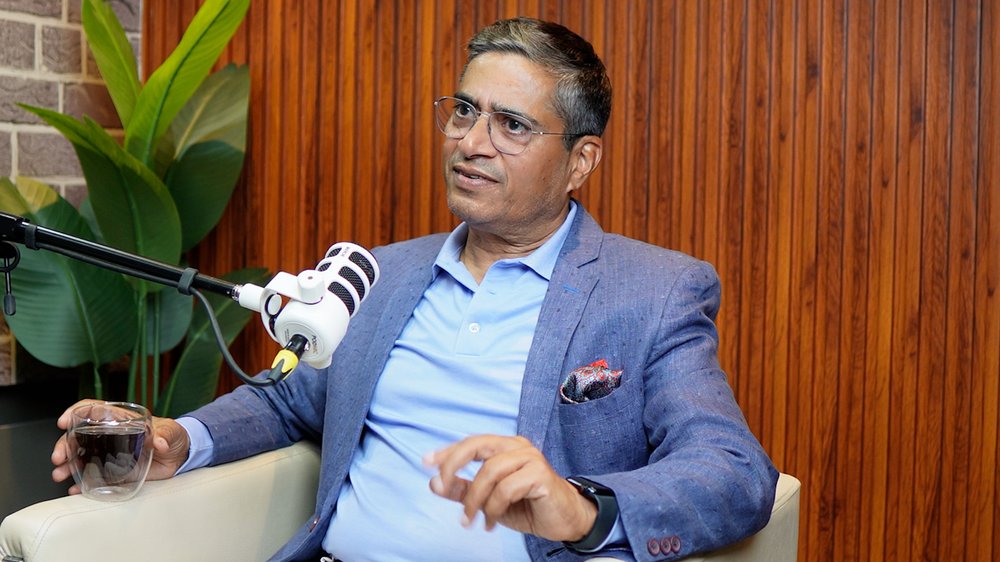
Kunwer Sachdev
Inverter Man of India
30+ years in inverter & battery industry
📅 June 2026⏱ 9 min read🇮🇳 India · Commercial e-rickshaw
2026 e-rickshaw battery economics — the upfront price is only half the story.
Ask any e-rickshaw driver what worries them most and the answer is the same: the battery. It's the single biggest running expense, the thing that strands you when it dies, and the decision that quietly decides whether the rickshaw earns or loses money. In 2026 that decision comes down to one question: cheap lead-acid you replace constantly, or pricier lithium you barely touch?
This guide lays out the real 2026 prices and — more importantly — the total cost over five years, because the sticker price hides the truth.
⚡ The short answer
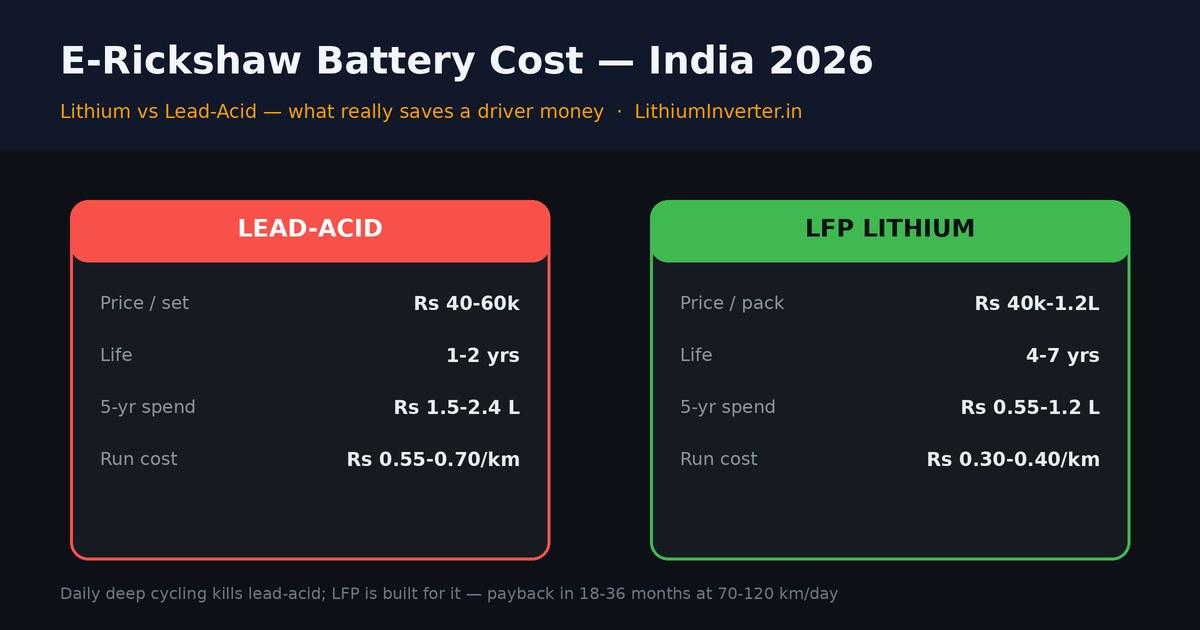
Lead-acid is cheaper to buy (₹40,000–60,000 a set) but you replace it every 1–2 years. LFP lithium costs more once (~₹40,000–1,20,000) but lasts 4–7 years and roughly halves your cost per km. For a driver doing 70–120 km a day, lithium usually pays for itself in 18–36 months — and saves a lot after that.
2026 E-Rickshaw Battery Prices
Battery
Price (2026)
Life
Lead-acid set (4–5 batteries)
₹40,000 – ₹60,000
1 – 2 years
LFP lithium (48V/60V, entry)
₹40,000 – ₹55,000
4 – 7 years
LFP lithium (higher capacity)
₹55,000 – ₹1,20,000
4 – 7 years
Indicative 2026 market prices; vary by brand, voltage and capacity. See live rates on the EV battery price index.
The Real Cost — 5 Years of Ownership
This is where lead-acid's "cheap" price falls apart. Over five years of daily driving, you'll buy 3–4 lead-acid sets — but only one lithium pack.
Over 5 years
Lead-Acid
LFP Lithium
Battery purchases
3–4 sets
1 pack
Total battery spend
₹1.5 – ₹2.4 lakh
₹0.55 – ₹1.2 lakh
Running cost / km
₹0.55 – 0.70
₹0.30 – 0.40
Maintenance
Water top-up, sulphation
None
Downtime
Frequent (replacements)
Rare
"Lead-acid is cheap the day you buy it and expensive every day after. Lithium is the opposite."
Add the fuel-vs-charge saving — lithium's lower per-km cost on a vehicle running 100 km a day is roughly ₹20–30 saved daily, or ₹7,000–10,000 a year — and the gap widens further in lithium's favour.
Why Lithium Lasts So Much Longer
Deep daily cycling: an e-rickshaw drains its pack hard every day. Lead-acid hates that and ages fast; LFP lithium is built for it (3,000–6,000 cycles).
Weight: a lead-acid set is heavy (cuts range and tyre/motor life); lithium is a fraction of the weight, so the same charge goes further.
Charging: lithium charges faster and fuller, with a BMS protecting every cell — lead-acid needs careful, slow charging and water top-up.
Heat & abuse: Indian roads and summers are punishing; LFP tolerates both far better.
The driver's maths: if you run the rickshaw daily as your livelihood, lithium is almost always the cheaper choice over any 3–5 year horizon — even though lead-acid wins on day one. The only cases for lead-acid are very light/occasional use or when you genuinely cannot fund the higher upfront cost (where some sellers now offer lithium on EMI or battery-rental).
From 30+ years in batteries — Kunwer Sachdev: The e-rickshaw is the clearest case in India for lithium. These vehicles do exactly what destroys a lead-acid battery — a deep discharge every single day — and exactly what an LFP battery is built to handle. I've watched drivers replace lead-acid sets two and three times while a lithium pack of the same era kept running. The thing to insist on is a genuine LFP pack with a real BMS and a proper charger; the cheap, unbranded packs that skip those are where the trouble starts. Buy the right lithium once, charge it properly, and it becomes the cheapest part of running the rickshaw.
Buying Tips & Battery Care
Insist on genuine LFP + a real BMS and a matched charger — avoid unbranded grey-market packs.
Match voltage/capacity to your controller (commonly 48V or 60V) and your daily km.
Get the warranty in writing — years and cycles — and keep the invoice with serial number.
Charge in the shade, avoid charging a hot pack right after running, and don't routinely drain to zero.
In 2026, a lead-acid e-rickshaw set costs ₹40,000–60,000 but you'll buy it again and again; an LFP lithium pack costs more once (₹40,000–1,20,000) and lasts 4–7 years while halving your per-km cost. For a working driver, lithium is the lower total cost almost every time. Buy a genuine LFP pack with a proper BMS and charger, look after it, and the battery stops being your biggest headache.
💰 BATTERY PRICES
Check today's independent e-rickshaw & EV battery prices.
What is the price of an e-rickshaw lithium battery in India?
About ₹40,000–1,20,000 in 2026 (commonly ~₹55,000 for a 48V/60V LFP pack), depending on capacity and brand.
How much is a lead-acid e-rickshaw battery set?
Around ₹40,000–60,000 for a set of 4–5 batteries, replaced every 12–18 months.
Which is better — lithium or lead-acid?
Lithium (LFP) for daily commercial use: longer life (4–7 years), lower running cost, lighter, no maintenance. Lead-acid only suits light or occasional use.
How long does an e-rickshaw battery last?
Lead-acid 1–2 years; LFP lithium 4–7 years under daily use.
Does lithium really save money?
Yes for working drivers — typically paying back the higher upfront cost in 18–36 months at 70–120 km/day, then saving on both replacements and per-km cost.
Founder of Su-Kam and Kunwwer.ai, and mentor at Su-vastika and several other companies — the “Inverter Man of India.” Read his story →
Disclaimer: This article is written by Kunwer Sachdev, mentor of Su-vastika. Kunwer Sachdev is no longer associated with Su-Kam Power Systems Ltd. in any capacity. Anyone dealing with Su-Kam should be aware that Kunwer Sachdev has no association with the Su-Kam brand or company.