Electric Car Battery Replacement Cost in India (2026): Replace or Write Off?
"What if the battery dies?" is the single biggest fear stopping Indians from buying an EV. The replacement numbers look scary — ₹4–8 lakh — but there's a crucial fact most headlines skip: an 8-year warranty means the vast majority of owners will never pay it. Here's the full picture.
Kunwer Sachdev
Inverter Man of India
30+ years in inverter & battery industry
📅 June 2026⏱ 10 min read🇮🇳 India · Electric cars
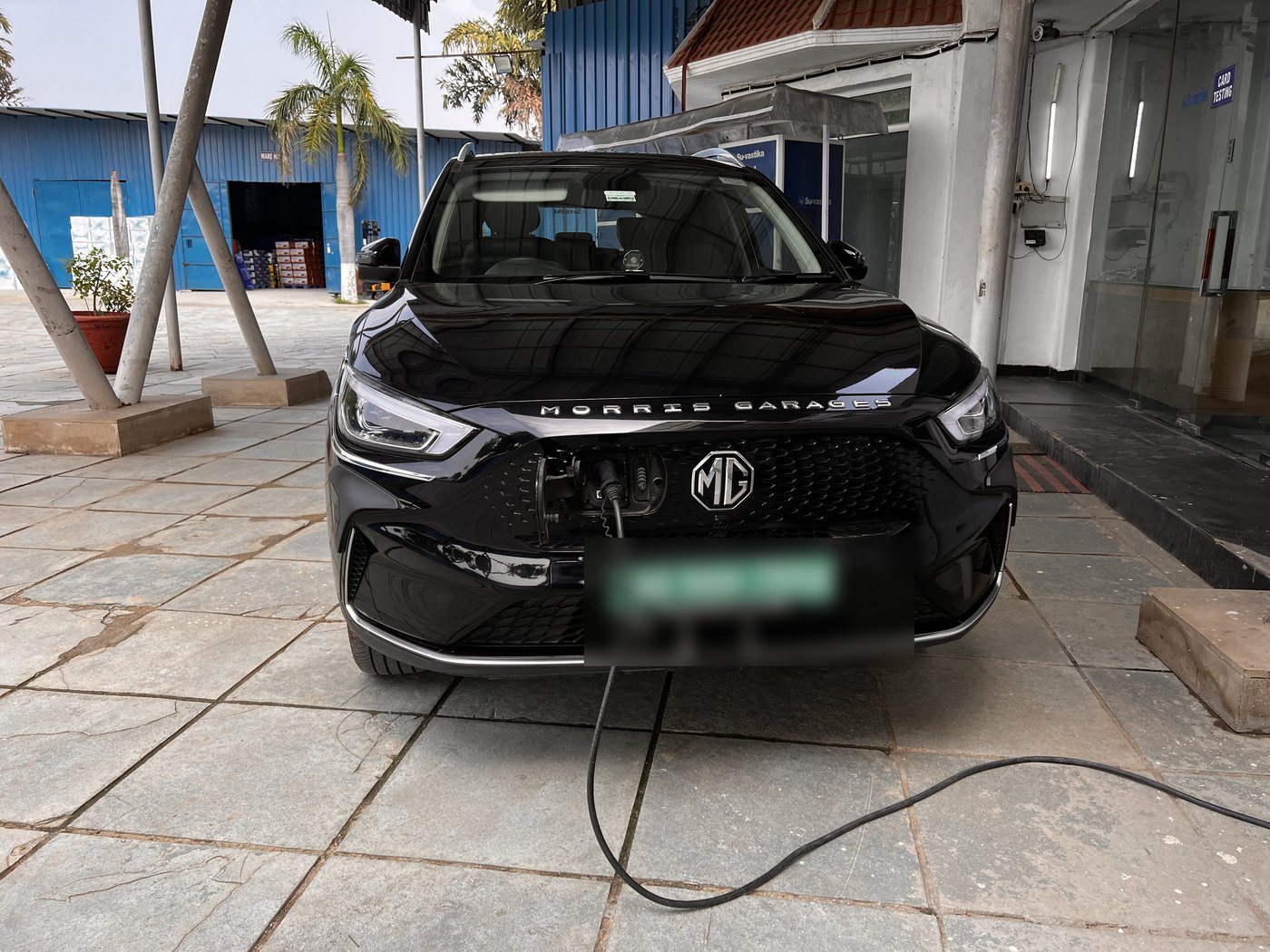
The author's own MG ZS EV on charge in India. The cost and warranty figures in this guide cover India's mainstream EVs — Tata Nexon & Tiago, MG ZS & Windsor, and others.
The number gets quoted to scare people off EVs: "a new battery costs ₹7 lakh." It's true — and also deeply misleading. Yes, an out-of-warranty pack for a popular electric car runs into lakhs. But almost no private owner pays it, because every mainstream EV in India ships with an 8-year battery warranty that replaces a failed or badly degraded pack for free.
This guide gives you both halves of the truth: the real replacement prices by model, and the warranty reality that makes those numbers irrelevant for most owners — plus exactly when replacement is worth it if you're ever out of cover.
⚡ The short answer
Out-of-warranty replacement runs ₹3.8–8.5 lakh (~₹15,000–20,000/kWh, about 30–40% of the car's price). But the standard 8-year / 1.6 lakh km warranty with a 70% State-of-Health floor covers most failures for free — and packs typically finish 8 years at 82–88% capacity. The scary number is real but rare.
2026 Replacement Cost by Model
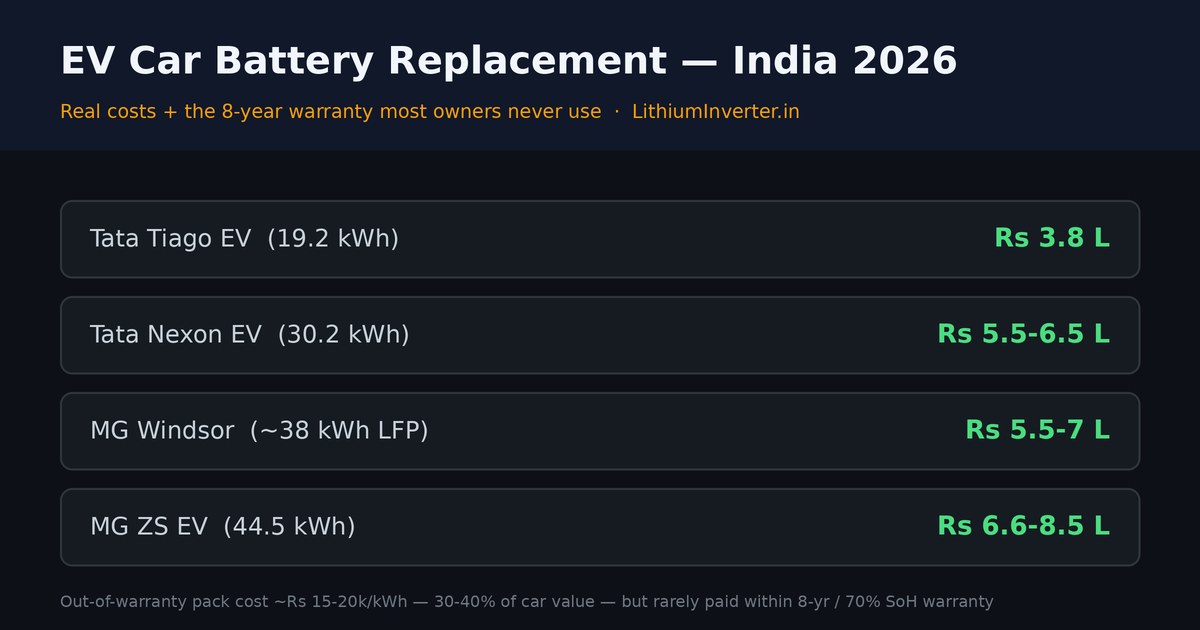
These are indicative out-of-warranty pack prices at authorised service centres in 2026. Cost tracks pack size (kWh) almost directly, at roughly ₹15,000–20,000 per kWh.
Model
Pack
Out-of-warranty cost
Tata Tiago EV
19.2 kWh
~₹3.8 lakh
Tata Tiago EV
24 kWh
₹4.0 – ₹4.8 lakh
Tata Nexon EV
30.2 kWh
₹5.5 – ₹6.5 lakh
Tata Nexon EV
40.5 kWh
₹6.5 – ₹7.5 lakh
MG Windsor (est.)
~38 kWh LFP
₹5.5 – ₹7 lakh
MG ZS EV
44.5 kWh
₹6.6 – ₹8.5 lakh
Figures are indicative 2026 estimates and vary by city, pack revision and labour. For the live range across the EV segment, see our electric car battery price index.
Out-of-warranty pack cost by model, 2026 — rarely paid within the 8-year warranty.
MG Windsor's twist — Battery-as-a-Service (BaaS): MG offers the Windsor with a battery-rental option, where you buy the car cheaper and pay per km for the battery, with the pack's health effectively MG's responsibility. It changes the replacement-risk equation entirely — worth understanding before you compare its sticker price to a conventionally-owned EV.
The Warranty Reality — Why Most Owners Never Pay
This is the part the scare-headlines leave out. Every mainstream Indian EV — Tata Nexon and Tiago, MG ZS and Windsor, Mahindra XUV400, Hyundai, BYD — carries an 8-year or 1.6 lakh km battery warranty (MG ZS 1.5 lakh km, Comet 1.2 lakh). Crucially, it includes a State-of-Health (SoH) floor, usually 70%.
If capacity drops below 70% within the term, the maker must repair or replace the pack — free. Degradation, not just total failure, is covered.
Tata goes further — a lifetime (15-year) HV battery warranty for the first owner on several models.
The warranty is transferable on all major Indian EVs, which protects resale value.
Most packs degrade ~2–3% a year and finish the 8-year term at 82–88% — above the 70% floor, so paid replacement is uncommon for typical use.
From 30+ years in batteries — Kunwer Sachdev: The fear of a lakhs-rupee battery bill is mostly misplaced for a new EV. Indian cars have moved heavily to LFP chemistry, which is not only safer but ages slowly and predictably — a well-managed pack with a good BMS loses only a few percent a year. The real risk isn't your warranty period; it's buying a used EV out of cover without checking the battery's State of Health. On a new car, the 8-year warranty does its job. On a second-hand one, the pack's SoH and remaining warranty are the most important numbers on the deal — more than the odometer.
Out of Warranty? Replace or Write Off
The hard case is an older EV, past 8 years or 1.6 lakh km, whose pack has finally degraded too far. Here the maths is brutal but simple: the pack is 30–40% of the car's original price, and the car itself has depreciated.
Write it off when the replacement quote approaches or exceeds the car's resale value — common on older EVs. You'd be spending lakhs on a vehicle worth not much more.
Replace only if the rest of the car is excellent, you love it, and a new pack genuinely resets it for years — and even then, negotiate hard and confirm it's a new (not refurbished) pack.
Watch the trend: cell prices keep falling (LFP hit $65–75/kWh globally in 2026), so out-of-warranty replacement is slowly getting cheaper each year.
Buying a used EV? Before anything else, get the battery's State of Health on record and check how much warranty transfers to you. An EV with 3 years of battery warranty left is a very different purchase from an identical one with zero. Treat SoH as more important than the odometer.
The Bottom Line
Yes, an EV car battery costs ₹3.8–8.5 lakh to replace out of warranty — and yes, that's a real number. But for a new EV it's a number you'll almost certainly never face: the 8-year / 70% SoH warranty covers degradation and failure, packs age slowly, and Tata even offers lifetime cover for the first owner. The fear is bigger than the risk. Where the maths gets real is older, out-of-warranty cars and used purchases — and there, the State of Health is the only number that matters.
💰 EV BATTERY PRICES
Track live EV car & scooter battery prices in India.
About ₹5.5–7.5 lakh out of warranty depending on the 30.2 or 40.5 kWh pack — but it's covered 8 years / 1.6 lakh km (lifetime for the first owner), so most owners never pay.
What does an EV car battery cost per kWh in India?
Roughly ₹15,000–20,000 per kWh in 2026, and falling as global LFP cell prices drop.
What's the EV battery warranty in India?
8 years or 1.6 lakh km with a 70% State-of-Health floor on most cars; Tata offers a lifetime (15-year) warranty for the first owner.
How fast do EV batteries degrade here?
About 2–3% a year; most packs finish 8 years at 82–88% capacity, above the 70% warranty floor.
Should I replace the battery on an old EV?
Usually not, if the quote nears the car's resale value. Within warranty it's free; out of warranty on an old car, writing it off is often the smarter call.
Founder of Su-Kam and Kunwwer.ai, and mentor at Su-vastika and several other companies — the “Inverter Man of India.” Read his story →
Disclaimer: This article is written by Kunwer Sachdev, mentor of Su-vastika. Kunwer Sachdev is no longer associated with Su-Kam Power Systems Ltd. in any capacity. Anyone dealing with Su-Kam should be aware that Kunwer Sachdev has no association with the Su-Kam brand or company.