EV Scooter Battery Spec Sheet 2026 — What Ola, Ather, TVS, Bajaj & Vida Publish (and What They Don't)
Every brochure shows kWh, a range number and a charge time. None of them shows the specs that decide how the battery ages, what your warranty really covers, or what the scooter is worth at resale. Here's the honest side-by-side — published specs first, missing specs flagged.
Kunwer Sachdev
Inverter Man of India
30+ years in inverter & battery industry
📅 June 2026⏱ 9 min read🇮🇳 India · Spec transparency series
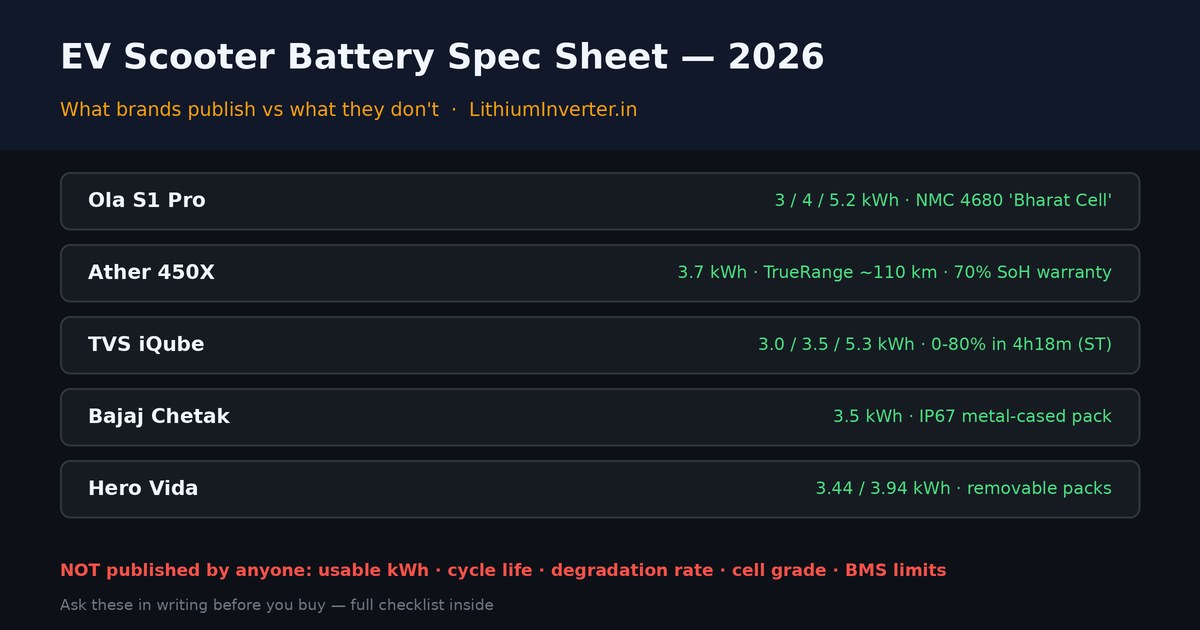
The 2026 spec sheet, side by side — green is published, red is what no brochure prints.
India's top electric scooters are sold on three battery numbers: capacity, range and charge time. Those numbers are real — but they're the easy ones. The specs that decide whether your pack is healthy at year five, whether your warranty claim succeeds, and what your scooter resells for, are mostly absent from every brochure. This is the first in our spec-transparency series: what each brand publishes, side by side, and the missing numbers to demand before you pay.
⚡ The short version
All five brands publish kWh, a range figure, charge time and warranty years/km. Ather goes furthest (real-world "TrueRange" + an SoH-based battery warranty); Ola is unusually open about its cell (4680 "Bharat Cell", NMC). Nobody publishes usable-vs-gross kWh, cycle life, the SoH floor in plain sight, cell grade, degradation rate or BMS limits. Those are the questions to ask in writing.
The Published Spec Sheet — Side by Side (2026)
Spec
Ola S1 Pro
Ather 450X
TVS iQube
Bajaj Chetak
Hero Vida
Pack options
3 / 4 / 5.2 kWh
3.7 kWh (2.9 Rizta)
3.04 / 3.5 / 5.3 kWh
3.5 kWh
3.44 / 3.94 kWh (removable)
Chemistry
NMC, 4680 "Bharat Cell"
NMC (21700)
Not prominent
Not prominent
Not prominent
Range claim
IDC figure
IDC + TrueRange (~110 km)
IDC (ST: 212 km claim)
IDC
IDC
0–80% charge
~4h50m home / ~45m fast
Published (home + grid)
~4h18m (ST)
Published
Published (removable)
Warranty
3 yr / 40,000 km (+ extended)
3 yr + Battery Protect (70% SoH)
3 yr / 50,000 km
3 yr / 50,000 km
3 yr / 30,000 km (offers vary)
Pack protection
Published (IP rating)
Published
Published
IP67, metal case
Published
Compiled June 2026 from brand spec pages and press material; variants change frequently — verify the exact variant with the dealer. Replacement pack prices are in our EV scooter battery cost guide.
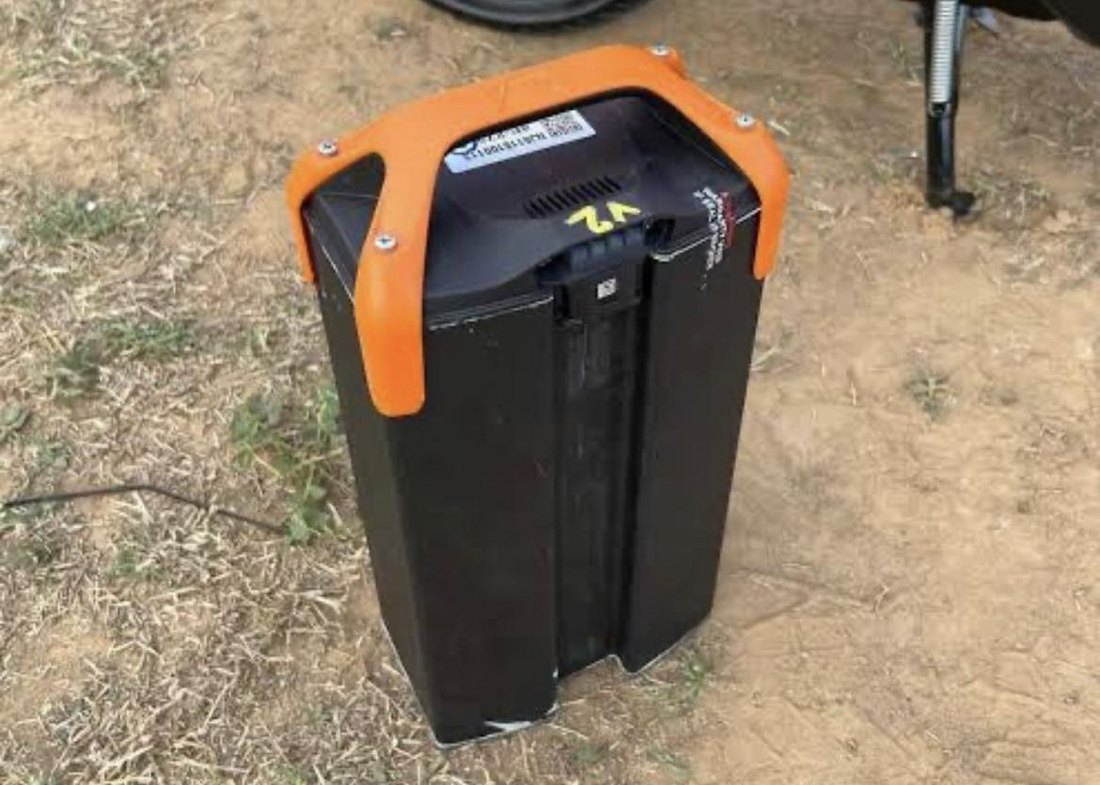
A removable EV scooter battery pack — the component every brochure describes in one number.
What's Missing From Every Brochure
Hidden spec
Why it matters
Status across all 5
Usable vs gross kWh
The BMS reserves capacity; your "4 kWh" is not 4 kWh usable. Decides real range.
Not published
Cycle life
How many charge cycles before meaningful fade — the lifespan number.
Not published
SoH floor, in plain sight
The % capacity that triggers free warranty replacement. Buried in T&Cs if at all (Ather states 70%).
Buried / varies
Degradation rate
Expected capacity at year 3, 5, 8 — what your resale depends on.
Not published
Cell supplier & grade
Who made the cells and to what grade (Ola's Bharat Cell is the exception).
Mostly not published
Fast-charge impact
How often you can fast-charge without accelerating fade or affecting warranty.
Not published
BMS limits & data access
Continuous current, thermal cutoffs, and whether you can read battery health for resale.
Not published
The pattern: the published specs are the ones that sell the scooter on day one. The hidden specs are the ones that decide what it costs you in year four. That asymmetry is not an accident.
"IDC range sells the scooter. State of Health decides what it's worth when you sell it."
Transparency Verdict
Most transparent: Ather — publishes a real-world TrueRange alongside IDC, and its Battery Protect warranty states the 70% SoH assurance openly. That's the standard others should match.
Most open on the cell: Ola — naming the 4680 Bharat Cell and NMC chemistry is more than most automakers disclose anywhere.
Build disclosure: Bajaj — the IP67 metal-cased pack is a genuine, published durability spec.
The gap everyone shares: no cycle life, no usable kWh, no degradation curve, no BMS detail. On those, all five are equally silent.
From 30+ years in batteries — Kunwer Sachdev: A scooter battery is cycled hard every single day, so the numbers that matter are the ones about ageing — cycle life, usable capacity, and the SoH floor in the warranty. Those are exactly the numbers missing from every brochure. My advice to buyers is simple: before you pay, get three things in writing from the dealer — the usable kWh, the SoH percentage that triggers a free replacement, and today's replacement pack price. The brand that answers all three without hesitation is telling you something about its battery. The one that won't is telling you something too.
Ask These 6 Questions Before You Buy
Usable kWh — not the gross number on the brochure.
Real range at my speed — not IDC. (Ather's TrueRange shows it can be done.)
SoH floor — what % battery health triggers free warranty replacement, in writing.
Cycle life / expected health at year 5 — any number they'll commit to.
Fast-charging limits — how often is safe, and does heavy fast-charging affect the warranty?
Replacement pack price today — so you know the true cost of ownership (see our price guide).
The Bottom Line
On published specs, India's top five electric scooters are easy to compare — kWh, range, charge time, warranty. On the specs that actually govern battery life and resale value, every brochure goes quiet. Use the table above for what's public, and the six questions for what isn't. A brand that answers in writing earns your money; silence is also an answer.
Frequently Asked Questions
What battery does the Ola S1 Pro use?
3, 4 or 5.2 kWh packs (Gen 3) on Ola's 4680 "Bharat Cell", NMC chemistry; 0–80% in ~4h50m at home or ~45 minutes on a Hypercharger.
Which brand is most transparent about its battery?
Ather — it publishes real-world TrueRange and a 70% SoH assurance in its Battery Protect warranty. Ola is the most open about its cell.
What specs do scooter brands hide?
Usable vs gross kWh, cycle life, degradation rate, SoH floor (often buried), cell supplier/grade, fast-charge impact and BMS limits.
Is IDC range realistic?
No — real range is typically 25–40% below IDC. Treat IDC as a best case.
What should I get in writing before buying?
Usable kWh, the SoH floor for warranty replacement, and today's replacement pack price.
Founder of Su-Kam and Kunwwer.ai, and mentor at Su-vastika and several other companies — the “Inverter Man of India.” Read his story →
Disclaimer: Specifications compiled from public brand material as of June 2026 and may change with variants and updates; "not published" reflects consumer-facing spec pages, not internal engineering data. Independent educational analysis — no brand paid to appear. Written by Kunwer Sachdev, mentor of Su-vastika; no longer associated with Su-Kam Power Systems Ltd. in any capacity.