The Battery Spec Sheet India Deserves — and No One Publishes
After 30+ years building inverters and batteries for this country, I can state it plainly: what the industry calls a "spec sheet" is a marketing leaflet. Here is what a real one looks like — every line of it measurable, every line of it missing today — and why our regulators must make it mandatory.
Kunwer Sachdev
Inverter Man of India
30+ years in inverter & battery industry
📅 June 2026⏱ 11 min read🇮🇳 India · Opinion & analysis
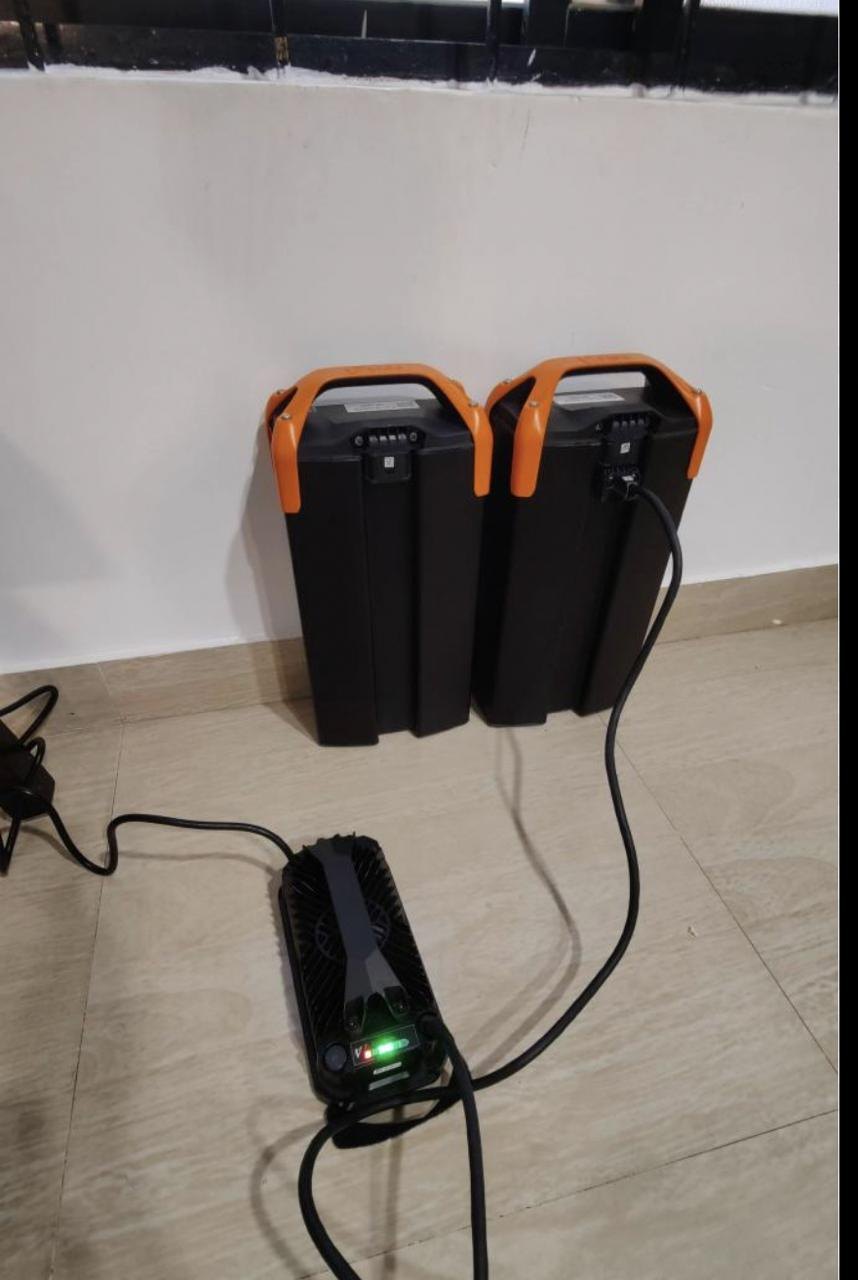
Removable EV battery packs on charge. The charger's output current and the pack's cutoff voltages decide this moment — and neither is printed anywhere the buyer can see.
We verified it on this site this week: the official, downloadable spec sheet of one of India's most respected EV makers contains exactly two battery lines — an energy figure in kWh and a warranty. No voltage. No ampere-hours. No charging current. No cutoff voltages. And that maker is one of the better ones. This is the state of battery "specifications" in India in 2026.
So instead of only criticising, this page does something more useful: it publishes the complete spec sheet every battery sold in India should carry — for EV scooters, home inverters, solar storage, all of it — explained line by line, with the reasons each number protects the buyer.
⚡ The principle
A battery's identity is voltage × ampere-hours — kWh is just their product. Its safety is its BMS cutoffs and current limits. Its honesty is state of charge defined by voltage. And its ageing is measurable through internal resistance and backup-time-at-load. A spec sheet without these is not a spec sheet.
1. Identity: Voltage and Ah, Not Just kWh
"3.7 kWh" tells you energy, not architecture. The real identity is the nominal voltage (set by chemistry and cell count — e.g., a 14s NMC pack ≈ 50.4 V; a 16s LFP pack = 51.2 V) and the capacity in Ah (3.7 kWh ÷ ~51 V ≈ 72 Ah). Without V and Ah you cannot match a charger, size a replacement, or compare two packs honestly. Every brochure should state: chemistry, cell configuration (e.g., 14s4p), nominal voltage, Ah, and gross vs usable Wh.
2. The BMS Section — the Specs That Prevent Disasters
The Battery Management System is the battery's bodyguard, and its settings decide both safety and life. These four numbers must be published, because without them a buyer cannot know if a charger is safe for the pack:
BMS spec
What it is
Why the buyer needs it
High-voltage cutoff (charge)
The pack voltage at which charging must stop (e.g., 4.2 V/cell NMC, 3.65 V/cell LFP)
A charger exceeding this overcharges the pack — the classic cause of swelling and fire
Low-voltage cutoff (discharge)
The voltage at which the BMS disconnects the load
Protects against deep discharge, the silent killer of lithium life
Maximum charge current
The highest current at which the pack may be charged — and whether the BMS enforces a charge-current cutoff
Defines which chargers are safe; fast-charging beyond it cooks the cells
Charger rated output
The supplied charger's voltage profile and output current
So a replacement charger can be matched exactly — wrong chargers destroy more batteries than age does
How deep this really goes
A professional-grade BMS datasheet goes far deeper than these four numbers — alarm, protection and recovery thresholds each with time delays, at both cell and pack level, balancing parameters, separate temperature limits, even the BMS's own self-consumption current. That depth deserves its own dedicated article, which this site will publish as part of the spec-transparency series. For this manifesto, the four numbers above are the floor every buyer should demand.
Every assembled battery in India sits on a BMS that has this entire table defined inside it. The manufacturer holds the document. The buyer gets "long life." That gap is the whole problem.
And one more fact that removes every excuse: a BMS is a BMS. Whether it sits inside a 12.8 V inverter retrofit, a 51 V scooter pack, a 350 V car battery or a solar wall unit, the parameter list is identical — over-charge, over-discharge, over-current, temperature, balancing, cutoffs. Only the values change with voltage class and current rating. That means one disclosure standard fits every battery sold in India, across every segment. No manufacturer in any category can claim their product is a special case that cannot be specified.
✍️ Kunwer Sachdev — in my own words
People assume every pack has charge-current protection. We don't actually know — because nobody publishes it. The manufacturer must state the high-voltage cutoff, the low-voltage cutoff, and the maximum charging current in writing. These three numbers are why a battery survives or dies, and they are exactly the three numbers you will not find on any Indian battery brochure today. That is how customers end up destroying good batteries with the wrong chargers — and then being told the warranty is void.
3. State of Charge Must Be Defined by Voltage
Every scooter and inverter shows a percentage. But a percentage is a software estimate; voltage is physics. If "80% charged" is defined by a published pack voltage, any user can verify it — with the dashboard readout or a ₹300 multimeter — and catch a battery meter that's drifting as the pack ages. The spec sheet should carry a simple table, like this illustration for a 16s LFP pack:
State of charge
Pack voltage (16s LFP, illustrative)
Per-cell
100% (charge cutoff)
58.4 V
3.65 V
~80%
~53.8 V
~3.36 V
~50%
~52.5 V
~3.28 V
~20%
~51.2 V
~3.20 V
0% (discharge cutoff)
~44.8–48 V
2.8–3.0 V
Illustrative values for the format; the exact table must come from each manufacturer for its own pack and chemistry. The point is the format: SoC anchored to voltage, published.
4. Ageing Must Be Measurable: Resistance and Backup-at-Load
A battery's decline should not be a mystery the service centre interprets for you. Two published baselines make ageing measurable by anyone:
Internal resistance — the health meter
Publish the pack's internal resistance when new, at full charge and at low charge. Resistance rises as a battery ages; comparing today's reading against the published baseline tells you — in one number — how much life is gone. Capacity at stated charge levels serves the same purpose.
Backup-at-load — the test anyone can run
Even simpler: the manufacturer states, for a new battery, "at 1000 W this pack delivers X minutes; at 2000 W, Y minutes." The owner runs the same test once a year. If the 1000 W backup has fallen from 60 minutes to 45, the battery has lost 25% — no app, no service centre, no argument. This single line on a spec sheet would end most warranty disputes before they start.
"If the brochure told you 60 minutes at 1000 watts on day one, nobody can argue with your stopwatch in year three."
The Model Spec Sheet — Demand This Format
Here is the complete template. Every line is measurable on standard equipment. Print it, hand it to any seller, and ask them to fill it in:
#
Specification
Example format
1
Chemistry & cell configuration
LFP, 16s2p / NMC, 14s4p
2
Nominal voltage
51.2 V
3
Capacity
72 Ah (gross) / 65 Ah usable
4
Energy
3.7 kWh gross / 3.3 kWh usable
5
High-voltage cutoff (charge)
58.4 V (3.65 V/cell)
6
Low-voltage cutoff (discharge)
44.8 V (2.8 V/cell)
7
Max charge current / charger output
20 A max · charger: 54.6 V, 10 A
8
Max continuous / peak discharge
60 A continuous / 120 A 10 s
9
SoC–voltage table
100/80/50/20/0% with pack voltages
10
Internal resistance (new)
X mΩ @ full · Y mΩ @ 20%
11
Backup at stated loads (new)
1000 W → X min · 2000 W → Y min
12
Cycle life, with conditions
3000 cycles @ 80% DoD to 80% capacity
13
Operating temperature & derating
−10 to 55°C; derate above 45°C
14
Cell maker, grade & origin
A-grade, [maker], [country]
15
Warranty: free vs pro-rata + SoH floor
36 mo free + 24 pro-rata; replace <70% SoH
Proof It Can Be Done — A Real Spec Sheet, Filled In
Is this template a fantasy? No. Here is an actual technical specification document for a 12.8 V / 100 Ah LFP retrofit inverter battery sold in India today (Su-vastika, doc. TS/BMS/BT12 — transparency: the author mentors Su-vastika; this sheet is shown as evidence of format, not as a product endorsement):
Parameter
Specified value
Template line it fills
Battery type
LiFePO4
#1 Chemistry
Rated capacity
100 Ah
#3 Ah ✓
Energy
1280 Wh (= 12.8 V × 100 Ah — the identity, demonstrated)
#2, #4 ✓
Charge method
CC-CV
#7 ✓
Charging current
Max 25 A
#7 Max charge current ✓
Discharging current
Max 100 A
#8 Max discharge ✓
Max charging voltage
14.0 V ± 0.1 V
#5 HV cutoff ✓
Battery low cut
11.0 V ± 0.1 V
#6 LV cutoff ✓
Protections
LV cut, HV cut, overload, short circuit, over-temperature
BMS protections ✓
Over-temp cutoffs
Charge >60 °C · discharge >65 °C · working 0–50 °C
#13 ✓
Cycle life, with conditions
≥3500 cycles @ 1C, 80% DoD, to 70% EoL, 25 °C
#12 — the honest format ✓
Efficiency
≥95% @ 50 °C · ≥75% @ 0 °C
Efficiency ✓
Backup at stated load
400 W bulb load → 3 hours
#11 — the degradation self-test ✓
Recharge time
4 h 30 m at 20 A
Charging ✓
Thirteen of the fifteen template lines, on one page, from one Indian factory. The two it could still add — the SoC-voltage table and internal resistance baselines — I will say openly should be added too; the standard applies to everyone, including companies I mentor. But the point is made: every number in the template exists in every factory. Publishing them is a choice. If a retrofit inverter battery can carry this sheet, a ₹1.5-lakh electric scooter has no excuse.
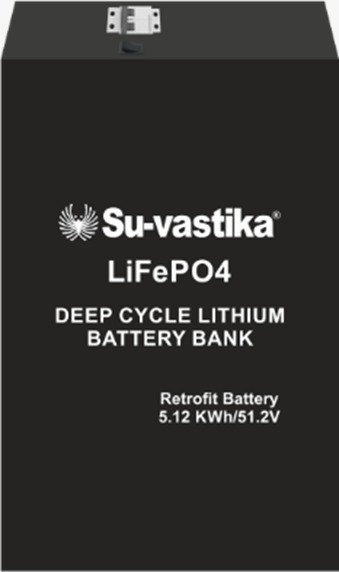
A label that states the electricals: 5.12 kWh at 51.2 V — from which 100 Ah follows directly. Voltage on the label is the start of honesty. (Author mentors Su-vastika.)
Where Is the Regulator?
India mandates safety testing — AIS-156 for EV packs, BIS standards for lithium cells — and that is good. But safety certification is not disclosure. A refrigerator must carry a BEE star label; a packet of biscuits must declare its contents; a battery costing ₹50,000 to ₹8 lakh is sold on a single kWh number. In my view this opacity shortchanges every Indian buyer, and the fix is simple: a mandatory standard battery label — the fifteen lines above — on every battery sold in this country. The manufacturers already have every one of these numbers; they test them in the factory. They are simply not required to print them.
✍️ Kunwer Sachdev — in my own words
There are no specifications being followed in this industry — and the buyer pays for that, every single time, in dead batteries, rejected warranty claims and wrong chargers. I have spent three decades on the manufacturing side. I know these numbers exist for every pack, because no factory can build a battery without them. Publishing them costs nothing. The only thing opacity protects is the weaker product. I will keep writing on this subject until the label exists.
The Bottom Line
Demand the fifteen lines. A manufacturer who fills the template in writing is selling you a battery; one who won't is selling you a number on a sticker. Until our regulators mandate a standard battery label, this page is that label — use it.
Frequently Asked Questions
What should a complete battery spec sheet contain?
Voltage and Ah, chemistry and cell configuration, BMS high/low-voltage cutoffs, max charge current and charger output, max discharge current, an SoC-voltage table, internal resistance when new, backup at stated loads, cycle life with conditions, temperature range, cell grade and the warranty's free/pro-rata split with SoH floor.
Why do BMS cutoffs matter to me?
They define what charger is safe for your pack. Unpublished cutoffs are how wrong chargers destroy batteries — and how those failures get blamed on you.
Why define charge by voltage?
Percentages are software guesses; voltage is measurable physics. A published SoC-voltage table lets anyone verify the meter.
How do I measure my battery's ageing?
Against published baselines: internal resistance vs the new-battery value, or the backup-at-load test — re-run "X minutes at 1000 W" yearly and read the decline directly.
Doesn't BIS already cover this?
BIS and AIS standards cover safety testing, not consumer disclosure. There is no mandated spec label for batteries in India today.
Founder of Su-Kam and Kunwwer.ai, and mentor at Su-vastika and several other companies — the “Inverter Man of India.” Read his story →
Disclaimer: This article is written by Kunwer Sachdev, mentor of Su-vastika. Kunwer Sachdev is no longer associated with Su-Kam Power Systems Ltd. in any capacity. Anyone dealing with Su-Kam should be aware that Kunwer Sachdev has no association with the Su-Kam brand or company.
This is an opinion and analysis piece on specification disclosure practices across the battery industry; it does not allege illegality by any specific company. Illustrative voltages are format examples, not brand data.